
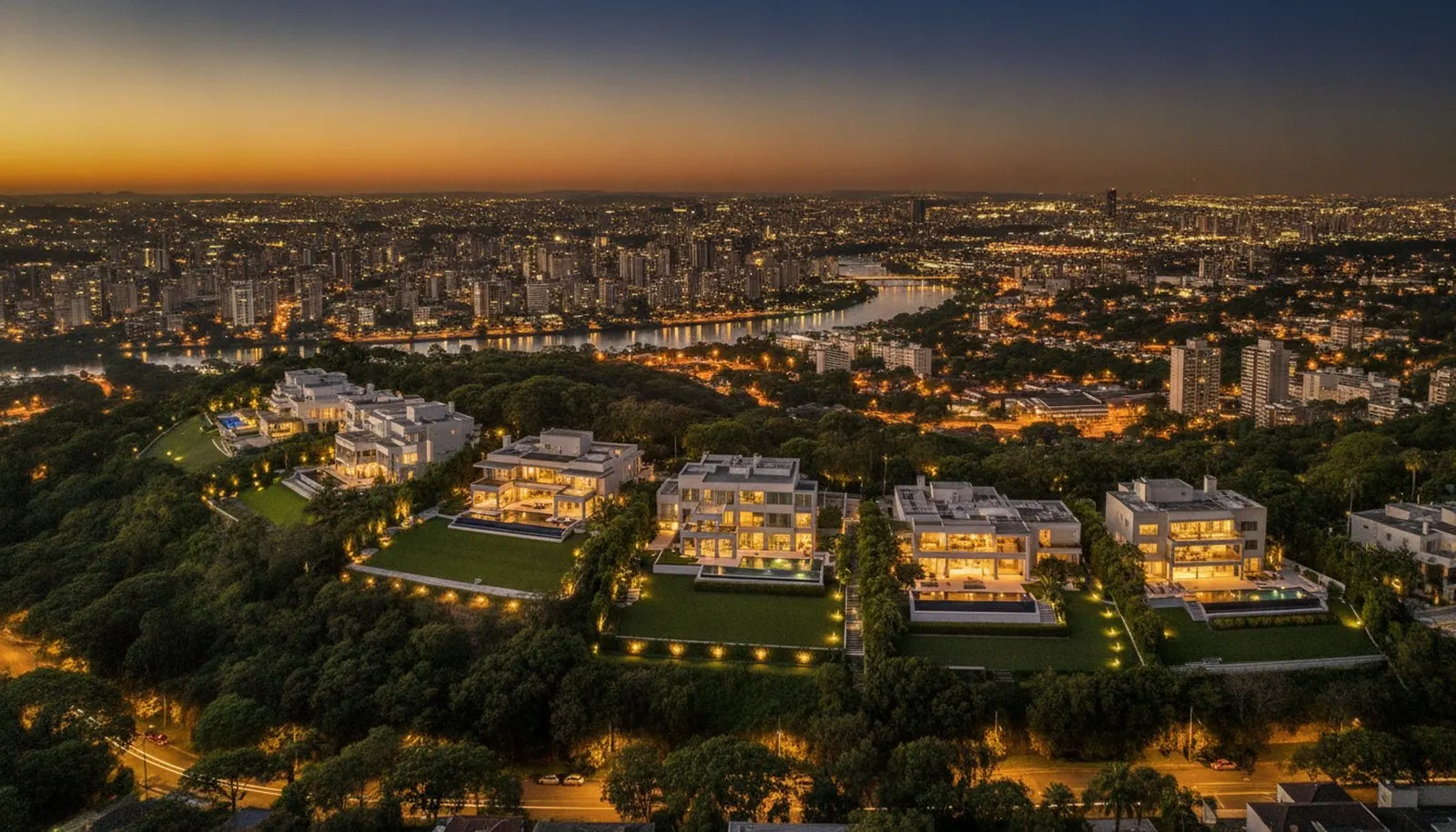
The neighbourhood’s story
The name is Tupi and describes the terrain: morõ plus the locative suffix, “place of the hill” — and some read it as “hill of the wind”, after the air currents off the hills. Until the mid-twentieth century this was the Fazenda do Morumbi, some seven hundred alqueires belonging to the Englishman John Rudge, who grew tea there; the estate’s oldest document dates from 1825. What remains of the farm is the Capela do Morumbi, at Avenida Morumbi 5387: rammed-earth walls completed with masonry in 1950, in a design by Gregori Warchavchik, with frescoes by Lúcia Suanê, who painted angels with indigenous features in the baptistery. Restored in 1980, it is now part of the Museu da Cidade de São Paulo.
The neighbourhood only became an autonomous district on 20 May 1992, under Municipal Law 11.220, split off from the former district of Pinheiros — before that it was a “peace district”, a registry and electoral entity, not an administrative one. In the meantime, the region had already received what defines it today. The Palácio dos Bandeirantes, at Avenida Morumbi 4500, began in 1955 as the seat of a university that Count Francisco Matarazzo Júnior wanted to found and never installed; the works stalled for lack of funds, the property was expropriated, and it became the seat of the São Paulo State Government on 19 April 1964. Facing it stands the Fundação Maria Luisa e Oscar Americano: the modernist house by Oswaldo Bratke where the couple lived for two decades, with grounds by Otávio Augusto Teixeira Mendes, donated to the city in 1974 and opened to the public in 1980 — 75,000 m² of forest within the neighbourhood.
Morumbi as the market knows it is bigger than Morumbi as the postal code defines it. The name covers, in everyday use, Jardim Guedala, the Paineiras do Morumbi and Panamby, each of which the postal service registers under its own neighbourhood name. And there is the well-known inversion: the Morumbi shopping centre is not in Morumbi — it sits on Avenida Roque Petroni Júnior, on the other side of the Marginal Pinheiros, with a Brooklin postal code. The house rule holds both ways: the postal code governs the address, market usage governs the neighbourhood.
The local product is a house on an original plot and a scattered tower, in a low-density layout that the topography imposed before the law confirmed it. There is no block left to redo the operation: what changes hands is what the farm had already divided up.
Morumbi: hill, forest and high walls. The neighbourhood that is home to the governor, the stadium and most of the city’s mansions.
The surrounding area
- Clubs: Clube Paineiras do Morumbi, next to Parque do Morumbi and the greenery of the Paineiras; across the river, in Cidade Jardim, the Jockey Club de São Paulo and the Esporte Clube Pinheiros, minutes away by bridge.
- Schools: Colégio Visconde de Porto Seguro, in the unit serving Panamby, the Graded School — The American School of São Paulo — on Avenida Giovanni Gronchi, and the network of international schools that spread along the Morumbi axis following the families.
- Dining and lifestyle: Shopping Cidade Jardim, on the other side of the Marginal, and Shopping Jardim Sul; within the neighbourhood, the offering is more residential than street-based — street-front retail settled on Giovanni Gronchi, and the rest is handled by car.
- Parks: Parque do Morumbi, Parque Alfredo Volpi on the Jardim Guedala side and Parque Burle Marx in Panamby; add to that the forest of the Fundação Oscar Americano, which functions as a park without being one.
In the Fragata archive
There are 2 developments from the portfolio with a Morumbi postal code: Vila Emílio Pedutti, on Rua Emílio Pedutti — a gated house village that the market rightly advertises as Jardim Guedala. The neighbourhood’s name comes up many other times in the archive without being an address: it is the surrounding-area reference for Hípica Max Garden, in the southern zone, and for the entries of Paineiras do Morumbi and Panamby, which are Morumbi in usage and something else on the postal code.