
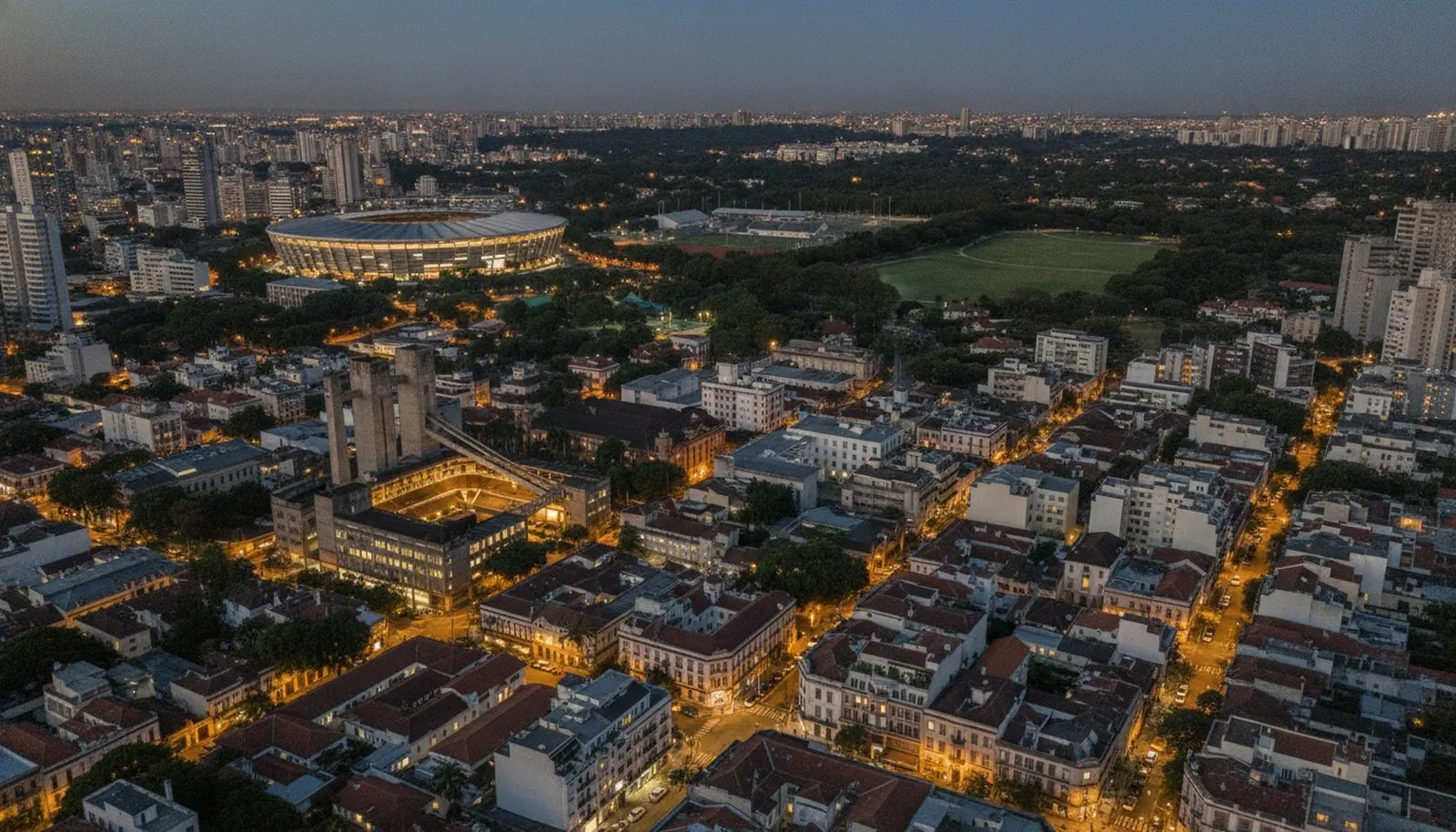
The neighbourhood’s story
Lapa is the centre-neighbourhood of the district of the same name, in the western zone, and it is from here that everything else radiates. Occupation began early: there is a record that in 1561 the Jesuits were granted a sesmaria in the region, then bathed by the Emboaçava River — today’s Pinheiros River —, and named by the indigenous people “Emboaçava”, meaning “place through which one passes”. Among the properties of that stretch, the “little farm of Lapa” stood out from the mid-eighteenth century onward. The Jesuits left the place around 1743, due to the rough terrain and the lack of labour, and the region returned to being almost nothing: a few years later, the whole stretch recorded five houses and thirty-one inhabitants. There are two versions of the name’s origin, and neither has been proven — one about a Portuguese man who carried an image of Our Lady and built a grotto for the saint, and another about the annual mass the Jesuits held for their patron saint.
It was the railway that made the neighbourhood. In 1867 the English of the São Paulo Railway opened the line between Jundiaí and the Port of Santos, and one of the stops in the capital was next to the bridge on the estate of Colonel Anastácio de Freitas Troncoso, on the land that would become Lapa; in 1875 the Sorocabana Railway built a yard and station there. With the tracks came workshops and industries — the Vidraria Santa Marina glassworks and the Armour, Bordon, Swift and Wilson meatpacking plants —, and with them came workers and technicians from England, Croatia, Lithuania, Poland, Russia and Hungary, added to Italians from the north and from Venice, and to the Portuguese, Spanish, French and Syrian-Lebanese who were already arriving. The Italian imprint stayed on the map: the area’s first subdivision was called Vila Romana, and the streets were named after Roman emperors, generals and jurists.
Densification brought commerce, and it is commerce that defines Lapa to this day. In 1954 the Lapa Municipal Market — the Mercadão — was born, built on the site of the capital’s largest open-air market, today covering 4,840 m²; in 1968 the Shopping Center Lapa opened on Rua Catão, one of the city’s oldest shopping centres; and Rua 12 de Outubro became one of São Paulo’s busiest shopping streets. The railway infrastructure remains the neighbourhood’s distinguishing trait: it is served by lines 7-Ruby and 8-Diamond of the metropolitan train, direct heirs of the São Paulo Railway and the Sorocabana.
The urban fabric is well established and mid-scale — street-level shops on the ground floor, moderately-sized buildings above. The large plots stayed with the industrial past and moved to the neighbours: Vila Romana inherited the ten-thousand-square-metre estates, and Água Branca, the warehouses. Here, what gets renewed is the commerce, not the block.
Lapa: an English railway, a market hall and a shopping street. The centre the western zone uses before heading up to the garden neighbourhoods.
The surrounding area
- Clubs: ACM Lapa, on Rua Brigadeiro Gavião Peixoto, built in 1963 on land granted by the Companhia City; Sesc Pompeia, in the warehouse that Lina Bo Bardi converted, a few minutes away; and Allianz Parque, on the border with Água Branca and Perdizes.
- Schools: Colégio Santo Ivo, in Alto da Lapa, and the district’s traditional school network; Senac keeps two long-standing units within the neighbourhood, on Rua Tito and Rua Scipião, and the area’s colleges are all within the same radius.
- Dining and lifestyle: the Lapa Municipal Market and the shops of Rua 12 de Outubro; Teatro Cacilda Becker, on Rua Tito, the only City Hall-run theatre in the western zone; Praça Cornélia, with a craft and traditional-food fair on Saturdays; and the Tendal da Lapa, on the neighbourhood’s cultural calendar.
- Parks: Parque da Água Branca, 136,000 m² under heritage protection with the feel of a historic farm, and Parque Villa-Lobos, on the way to the river.
In the Fragata archive
Lapa is in the archive for what it organises. The whole district reads from here, and the three neighbourhoods the high-end market looks for already have an entry of their own: Alto da Lapa, a garden neighbourhood by Barry Parker frozen in place by the 2009 heritage listing; Vila Romana, with the condominium plots industry left behind; and Água Branca, on the other side, where large tracts of land still exist. There is no listed address within Lapa’s commercial perimeter yet, and the reason is one of form: the neighbourhood’s core is street-level commerce and mid-scale buildings, and the area’s high-end product was born in the neighbouring blocks, which inherited the land. Those who want to live in Lapa, not just use it, usually end up in one of the three — and that conversation starts with an advisor, who knows the exact boundary of each one.