
Neighborhood · São Paulo/SP
Água Branca
The neighbourhood born from a stream of clean water, turned industrial district because of two railways, and today where the western zone goes to watch a match, run in the park and film television.
The neighbourhood’s story
The name is literal: there was a stream of clear water cutting through the region, and it now runs channelled beneath Avenida Sumaré. The place was already known in 1822, when the French traveller Saint-Hilaire cited it as a route to Campinas; the land came from a royal land grant given to the Jesuits, confiscated by the government when the Society of Jesus was expelled in 1759. What turned the floodplain into a neighbourhood were the rails: the railway linking Santos to Jundiaí, from 1867, and the Sorocabana, opened in 1874. Wide, cheap land next to two railway lines is a recipe for factories, and from 1880 onward they came — with the Indústrias Reunidas Francisco Matarazzo at the forefront, which left its name on the main avenue and the square. Then came deindustrialisation, land appreciation and the shift to the tertiary sector, and the neighbourhood became somewhere passed through more than lived in.
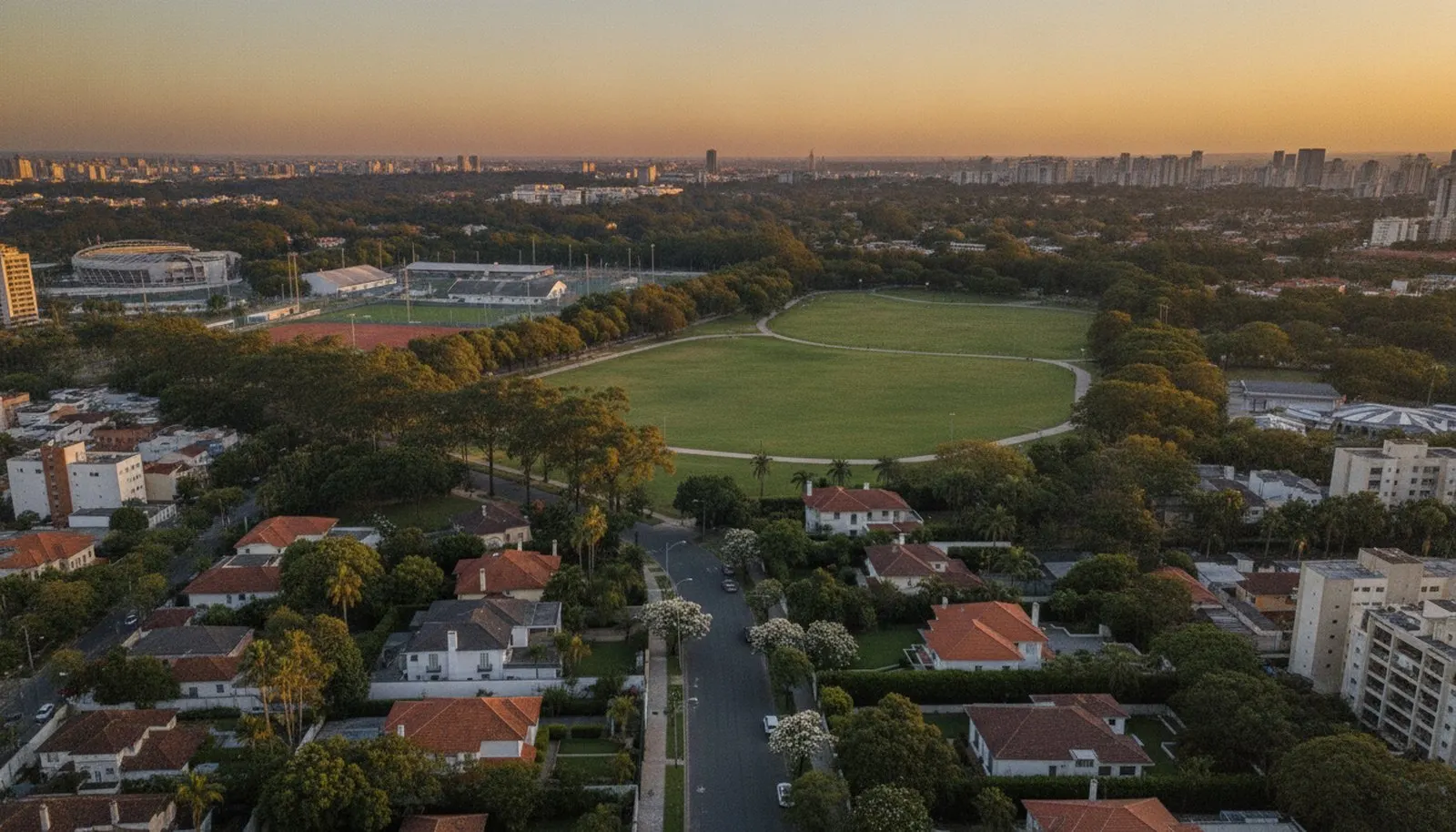
What remains standing is first-rate. The Parque da Água Branca — officially Parque Fernando Costa — began taking shape in 1905, on the initiative of the Sociedade Rural Brasileira, and was opened on 2 June 1929, when the avenue in front didn’t yet have asphalt. It covers 136,765 m² of forest, a lake, a dovecote and livestock exhibition pavilions, listed as heritage by Condephaat in 1996 and by Conpresp in 2004; to this day the park houses the Instituto de Pesca, breeders’ associations and an organic produce fair. A few blocks away, Allianz Parque was built on the site of the former Parque Antártica, and the TV Cultura studios close off the triangle. Administratively, Água Branca is a neighbourhood of the Barra Funda and Lapa districts, under the Lapa sub-prefecture, bordering Perdizes, Lapa, Limão and Freguesia do Ó. And the boundary with Perdizes is finer than it looks: Avenida Francisco Matarazzo and Praça Conde Francisco Matarazzo Júnior have an Água Branca postcode, while Rua dos Caetés, a block away, is already Perdizes.
It is one of the few places in the expanded centre where a large tract of land still exists — a legacy of the warehouses — and that is exactly why the ground here is under an urban operation, with an infrastructure schedule tied to each approval. Upscale residential product is recent and limited in number; what is being bought is the position, not the stock.
Água Branca: factory became stadium, floodplain became park. The corner of the western zone the whole city passes through to watch a match and leaves without knowing it’s a neighbourhood.
The surrounding area
- Clubs: the clubhouse and stadium of Sociedade Esportiva Palmeiras, at Allianz Parque, are the facility that sets the neighbourhood’s agenda; a traditional membership club, in the São Paulo sense, the neighbourhood does not have — the closest one is on the other side of Perdizes.
- Schools: the offering comes from the neighbouring districts, all minutes away: PUC-SP on the Monte Alegre campus and the traditional schools of Perdizes, Vila Romana and Alto da Lapa.
- Dining and lifestyle: Allianz Parque as a concert venue as well as a stadium, the TV Cultura studios, Sesc Pompeia by Lina Bo Bardi a few minutes away via Avenida Pompeia, and the service businesses that have set up along Avenida Francisco Matarazzo.
- Parks: Parque da Água Branca, which is the neighbourhood’s main asset — 136,000 m² of listed heritage land, with a running track, a lake, a play area and an organic produce fair, a five-minute walk from much of the residential blocks.
In the Fragata archive
No address in the archive has an Água Branca postcode, and the reason is a matter of timing: the neighbourhood’s upscale residential stock is from the most recent crop, later than the portfolio. What does exist is the border, and it shows clearly: Parc Exclusif Perdizes, on Rua dos Caetés, is on the stretch of Perdizes that comes down towards here, on the walk to Parque da Água Branca; and Mondrian, in Sumaré, has the cultural and sporting axis of Água Branca within a five-minute radius, without inheriting the match-day traffic. Anyone who wants the address, not just its benefit, starts the conversation with an advisor — this is a neighbourhood where what matters tends to sell before it ever appears.