
Neighborhood · São Paulo/SP
Santana de Parnaíba
Not a neighbourhood: it is a municipality founded in 1580, one of the oldest in Brazil, with a historic centre listed by IPHAN — and home to much of Alphaville and Tamboré.
The neighbourhood’s story
Santana de Parnaíba was born in 1580, when Susana Dias, granddaughter of the chief Tibiriçá, and her son, Captain André Fernandes, established a farm on the banks of the Rio Anhembi — today’s Tietê — next to a waterfall the indigenous people called Parnaíba, “place of many islands”. Its position in the Tietê valley made the settlement a starting point for the bandeiras heading towards the São Paulo hinterland and Mato Grosso, and it was raised to a town in 1625. Then came the decline: with the end of the bandeiras, in the 18th century, the river’s waterfalls and the rugged terrain left the town off the routes linking São Paulo to Jundiaí, Sorocaba and Itu, and it went dormant. Not even the Edgard de Sousa hydroelectric plant, opened on the Tietê in 1901, changed that — over the course of the 20th century the municipality went on to lose territory to the former districts that became independent: Cajamar, Pirapora do Bom Jesus and Barueri.
What it lacked was a road. The turning point came in the 1980s, with improved road links to Greater São Paulo and the development of residential condominiums — Alphaville leading the way. The effect on the numbers is dramatic: the population, which stood at around 10,000 in 1970, jumped to 37,000 in 1980, 74,000 in 1991 and 154,105 in the 2022 Census. Today the economy runs on services and commerce, concentrated in the Alphaville area, with industry in the Fazendinha and Tamboré districts — where Telefônica opened, in 2012, a 33,600 m² data centre that runs the company’s telephony operations across the country.
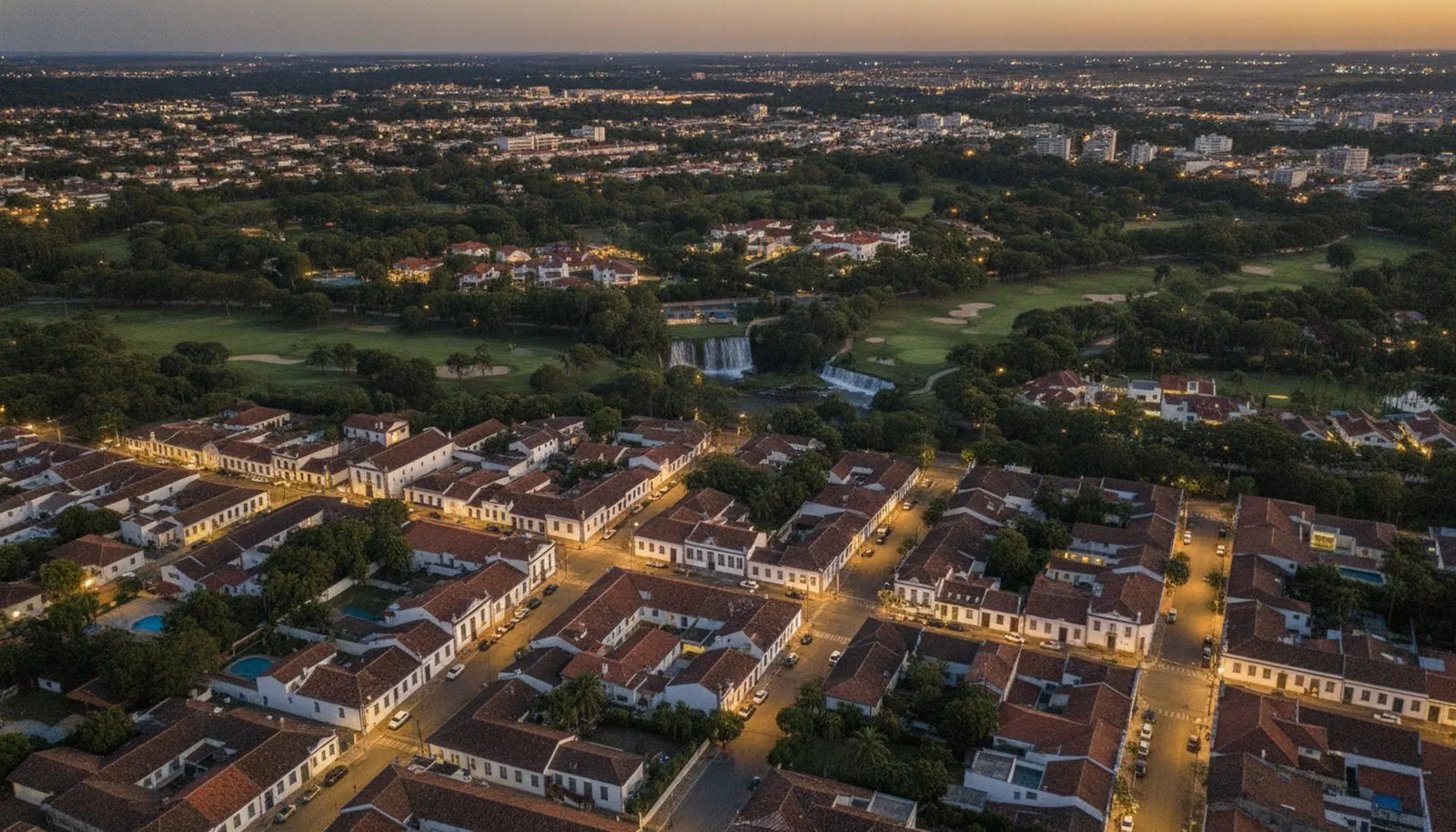
And there is the other half of the municipality, the older one, which almost no resident of the condominiums knows. The Centro Histórico de Santana de Parnaíba is the only preserved colonial architectural ensemble in the metropolitan region and one of the largest in the state: more than two hundred buildings from the 17th to the 19th centuries, many built in rammed earth and wattle-and-daub, listed by Condephaat and IPHAN. Standing there are the Igreja Matriz de Sant’Ana, the Casa do Anhanguera — today a museum, on Praça da Matriz — and the Monsenhor Paulo Florêncio mansion. The samba de bumbo, typical of the municipality, was recognised as intangible cultural heritage by IPHAN in 2024. It is a municipality with two cities inside it: the colonial one, of cobblestones and bandstand, and the one of guardhouses and thousand-square-metre plots, twenty minutes apart from each other.
The high end here was born from farm estates that were subdivided only once — the numbered Alphaville residential developments were completed back in the 20th century, and Tamboré divided up the remaining estate. No new perimeter opens: what changes hands is a plot within a layout that is already closed. And the historic centre is listed — there, one does not build, one restores.
Santana de Parnaíba: 1580 on one side of the bridge, Alphaville on the other. The oldest municipality in the metropolitan west has listed rammed-earth houses and the postcode of the region’s most expensive homes.
The surrounding area
- Clubs: each residential development works as its own club, with courts, a field, a track and a social clubhouse within the wall — some with golf training centres; the Alphaville Tênis Clube, from 1976, is the area’s historic meeting point and sits on the Barueri side, though the boundary means nothing in practice.
- Schools: the offering is that of Alphaville and Tamboré, shared with Barueri and used indiscriminately by both sides — the largest concentration of international schools in Greater São Paulo, with St. Nicholas, Escola Internacional de Alphaville, Escola Castanheiras, Pentágono, Anglo Leonardo da Vinci and Colégio Objetivo, plus the Alphaville campuses of Mackenzie and UNIP for higher education.
- Dining and lifestyle: Iguatemi Alphaville and Shopping Tamboré, plus the commercial and business centre that serves both municipalities; on the historic side, the Circuito dos Alambiques and a calendar of festivals that is the city’s true cultural product — Carnival, the Drama da Paixão staged on the banks of the Tietê, the Corpus Christi festival with sawdust carpets dating back to the 1960s, and the Natal de Luz, which draws 100,000 visitors.
- Parks: the greenery is private before it is public — areas of preserved woodland within the residential developments themselves, such as the Mata Voturussu in Alphaville Residencial 10. Outside the walls, the Morro do Voturuna, with the 1687 Capela de Nossa Senhora da Conceição at its top, the Figueira Centenária between the bridge over the Tietê and the historic centre, and the Estrada Ecoturística do Suru.
In the Fragata archive
There are 3 developments from the portfolio in the municipality: Alphaville Residencial 10, on Avenida Bom Pastor, and Tamboré 2, on Praça da China — both under the registry jurisdiction of the Registro de Imóveis de Santana de Parnaíba, the notarial office responsible for this entire stretch of high-end property. It is the boundary that explains the portfolio: Residencial 10 was built on the Parnaíba side in 1990, and Tamboré 2 occupies 686,000 m² on this side of the line, while its sibling Tamboré 1 is in Barueri.